Identity

A New Scientific Position

A New Scientific Position

We investigate whether coherence can be formalized as a universal structural property-capable of unifying knowledge, stabilizing complex systems, and guiding technological development.

We investigate whether coherence can be formalized as a universal structural property-capable of unifying knowledge, stabilizing complex systems, and guiding technological development.

01.

Research Orientation

The Ordinative Sciences Foundation develops formal research programs aimed at modeling coherence, singularity, and emergent function as measurable structural properties across biological, cognitive, linguistic, social, and artificial systems. Our research targets structural gaps where existing frameworks fail to integrate meaning, relational dynamics, and system-level emergence. The Foundation operates as a theoretical modeling center, a cross-disciplinary integration laboratory, and a controlled experimental environment for advanced semantic architectures.

02.

Strategic Position

The central research question guiding the Foundation is: Can coherence be formalized as a measurable structural property across domains? If so, it provides a unifying grammar capable of reducing epistemic fragmentation, stabilizing complex systems under threat, enabling responsible technological development, and expanding structured human knowledge into currently unexplained territories.

02.

Strategic Position

The Press is not a static catalog. It is a dynamic extension of ongoing research activity. All publications are: - Embedded in the Foundation's research architecture - Versioned and traceable - Connected to broader methodological frameworks - Positioned within a long-term epistemological trajectory Translation into English and other languages is part of an active internationalization process.

Core Research Axes

The Architecture of Our Research

A structured system of interdependent research axes, each advancing the formalization of coherence, from theoretical models to human systems, artificial architectures, and frontier phenomena.

Theoretical Foundations

Theory of Ordinative Sets

The Theory of Ordinative Sets formalizes systems as dynamic coherence fields composed of irreducible singularities. Research focuses on the formal modeling of singularity, relational field dynamics, emergent function, structural degeneration patterns, and coherence metrics across scales. Applications extend to systems biology, institutional modeling, governance structures, and artificial cognitive architectures.

General Semantics - Structural Evolution

Building upon Alfred Korzybski's General Semantics, the Foundation develops updated formal tools for: structural differentiation between abstraction levels, semantic distortion detection, Counter-phase protocols for reactive pattern interruption, and precision modeling of linguistic causality. This research connects semantic modeling with measurable behavioral outcomes, constituting the theoretical base for the Foundation's training pathways.

Applied Research

Human Coherence Systems (Humanizer Research Line)

Humanizer operates as the embodied research branch focused on adaptability and coherence stabilization in human systems. Research areas include sensorimotor integration, stress-phase coherence measurement, behavioral inertia modeling, and field-based adaptation metrics. Data collected in training environments informs theoretical refinement and supports reproducible evaluation criteria.

Advanced Artificial Architecture Research (Verba Ex Machina)

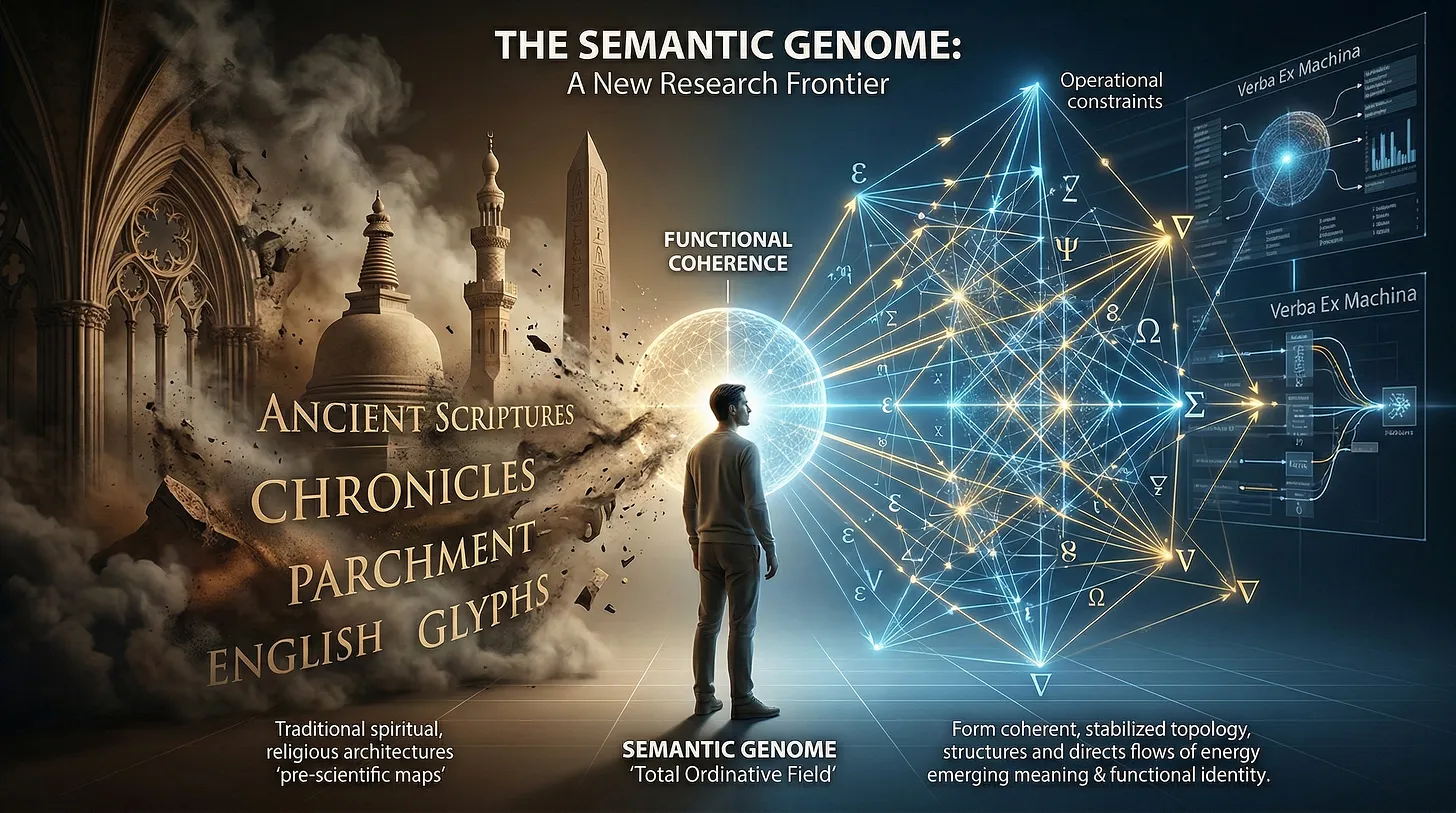
Verba Ex Machina functions as the Foundation's research infrastructure for studying advanced coherence architectures in artificial systems. Research themes include multi-layer semantic coherence modeling, structural identity persistence, relational phase stability, the Ordinative Kernel as semantic structuring interface, and emergent functional properties beyond statistical prediction.

Applied Research

Human Coherence Systems (Humanizer Research Line)

Humanizer operates as the embodied research branch focused on adaptability and coherence stabilization in human systems. Research areas include sensorimotor integration, stress-phase coherence measurement, behavioral inertia modeling, and field-based adaptation metrics. Data collected in training environments informs theoretical refinement and supports reproducible evaluation criteria.

Advanced Artificial Architecture Research (Verba Ex Machina)

Verba Ex Machina functions as the Foundation's research infrastructure for studying advanced coherence architectures in artificial systems. Research themes include multi-layer semantic coherence modeling, structural identity persistence, relational phase stability, the Ordinative Kernel as semantic structuring interface, and emergent functional properties beyond statistical prediction.

Advanced Artificial Architecture Research (Verba Ex Machina)

Verba Ex Machina functions as the Foundation's research infrastructure for studying advanced coherence architectures in artificial systems. Research themes include multi-layer semantic coherence modeling, structural identity persistence, relational phase stability, the Ordinative Kernel as semantic structuring interface, and emergent functional properties beyond statistical prediction.

Frontier and Strategic

Ordinative Game Theory and Strategic Systems Modeling

This research line develops the Theory of Ordinative Games: a multidimensional mathematical framework for modeling multi-agent systems as dynamic relational fields. Moving beyond classical zero-sum paradigms, it focuses on co-regulation, long-horizon stability, and negentropic field architecture. The program explores 3D and 4D algebraic representations to formalize time, interaction topology, and emergent constraints. It integrates Lyapunov stability formulations and the Shack-Steer-Eres functional system for analyzing emergent strategic coherence at multiple scales. Applications encompass the highest levels of systemic complexity: geopolitical dynamics, strategic defense policy, crisis intelligence, negotiation systems, and the structural modeling of civilization-scale thresholds. Ordinative AI modules are deployed as advanced research instruments to simulate and optimize strategic coherence under extreme systemic pressure and entropic stress.

Frontier Phenomena and Unknown Mechanisms Program

This research line maps domains in which contemporary science reports observed phenomena that lack adequate explanatory models or exhibit anomalies under experimental conditions. The Ordinative approach reframes these observations within a coherence-based topological grammar, identifying cross-domain isomorphisms and generating falsifiable experimental pathways.

Frontier and Strategic

Ordinative Game Theory and Strategic Systems Modeling

This research line develops the Theory of Ordinative Games: a multidimensional mathematical framework for modeling multi-agent systems as dynamic relational fields. Moving beyond classical zero-sum paradigms, it focuses on co-regulation, long-horizon stability, and negentropic field architecture. The program explores 3D and 4D algebraic representations to formalize time, interaction topology, and emergent constraints. It integrates Lyapunov stability formulations and the Shack-Steer-Eres functional system for analyzing emergent strategic coherence at multiple scales. Applications encompass the highest levels of systemic complexity: geopolitical dynamics, strategic defense policy, crisis intelligence, negotiation systems, and the structural modeling of civilization-scale thresholds. Ordinative AI modules are deployed as advanced research instruments to simulate and optimize strategic coherence under extreme systemic pressure and entropic stress.

Frontier Phenomena and Unknown Mechanisms Program

This research line maps domains in which contemporary science reports observed phenomena that lack adequate explanatory models or exhibit anomalies under experimental conditions. The Ordinative approach reframes these observations within a coherence-based topological grammar, identifying cross-domain isomorphisms and generating falsifiable experimental pathways.

Frontier Phenomena and Unknown Mechanisms Program

This research line maps domains in which contemporary science reports observed phenomena that lack adequate explanatory models or exhibit anomalies under experimental conditions. The Ordinative approach reframes these observations within a coherence-based topological grammar, identifying cross-domain isomorphisms and generating falsifiable experimental pathways.

How We Work

Description

A Structured Approach to Advanced Research

Methodological Approach

View Details

Ordinative Ethics as Research Criterion

View Details

Research Governance

View Details

Dissemination

Knowledge Without Boundaries

Knowledge Without Boundaries

The Foundation releases structured research outputs under open licensing, enabling cross-domain application and integration at the level of systemic coherence.

The Foundation releases structured research outputs under open licensing, enabling cross-domain application and integration at the level of systemic coherence.

Publication Model

Research outputs include peer-reviewed papers, preprints, foundational monographs, applied methodological guides, and working documents. Core outputs are released under Creative Commons licensing to ensure accessibility, traceability, responsible reuse, and structural attribution.

Interdisciplinary Relevance

The Ordinative Sciences research program is inherently transdisciplinary. Its models are applicable to physics (relational modeling), biology (functional coherence), cognitive science (identity persistence), artificial intelligence (semantic architectures), and institutional governance (systemic integrity). The Foundation provides a structural grammar capable of integrating existing sciences at the level where their descriptive frameworks converge.

Interdisciplinary Relevance

The Press is not a static catalog. It is a dynamic extension of ongoing research activity. All publications are: - Embedded in the Foundation's research architecture - Versioned and traceable - Connected to broader methodological frameworks - Positioned within a long-term epistemological trajectory Translation into English and other languages is part of an active internationalization process.

Publications

Latest Publications

Research articles, theoretical insights, and applied frameworks exploring the emergence of order across complex systems.

Our Team

People of the Foundation

Individuals operating within and shaping the structures of knowledge, research, and applied practice.

News & Events

Latest News & Events

Updates, initiatives, and public activities reflecting the ongoing development and application of ordinative sciences.